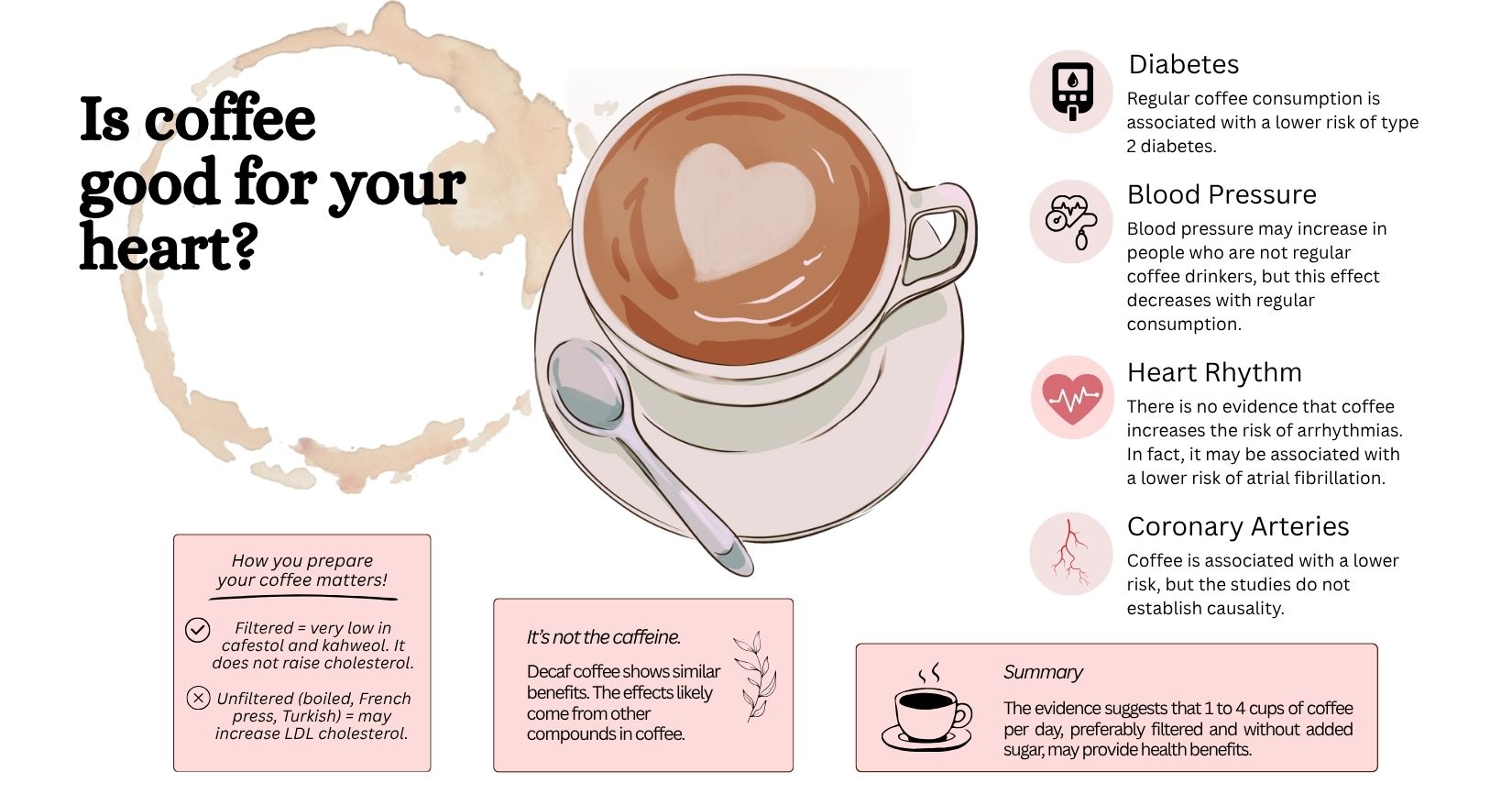
Is coffee good for your heart?
Coffee is one of the most widely consumed and studied beverages on the planet, and yet the answer is still not as simple. A review article in the European Heart Journal brought together decades of research on coffee and heart health. The Small Print brings you here the evidence, broken down into what we can say and what we can't.
What the review article found
The heart is a vital organ, but it rarely becomes diseased on its own. Most heart problems develop over years, driven by other underlying conditions such as high blood pressure, high cholesterol, and diabetes, combined with risk factors like physical inactivity and smoking. When someone is asking whether something is good or bad for the heart, they are really asking two different questions: does it affect those underlying factors, and does it have a direct effect on the heart itself? Coffee touches both pathways, and it does not always push them in the same direction.
Filtering coffee prevents it from raising your cholesterol
Unfiltered coffee contains two compounds, cafestol and kahweol, that raise blood cholesterol. A paper filter traps these compounds. So the amount that ends up in your cup depends on how you brew coffee: boiled, Turkish, Greek, and French press coffee contain high amounts of these compounds. Espresso and moka pot coffee contain intermediate amounts. Drip-filtered, sock-filtered, percolated, Indian-filtered, and instant coffee contain very small amounts.
How much can the way coffee is prepared affect cholesterol levels? To answer this question, researchers conducted trials in which people were assigned to drink a particular type of coffee rather than simply being asked what they normally drank. Filtered coffee did not raise cholesterol compared with no coffee. High amounts of unfiltered coffee, around six cups a day, did raise LDL cholesterol compared with filtered coffee, by about 0.39 mmol/L. With espresso, the effect on LDL increase exists but is smaller. This result was shown in a large UK study: people who drank two or more espressos a day had slightly higher LDL than those who drank none, about 0.11 mmol/L higher in men and 0.16 in women.
The idea that coffee promotes diabetes is not supported by the data
It has been reported that, in the hours after drinking coffee, caffeine reduces insulin sensitivity in both healthy people and people who already have type 2 diabetes. If we looked only at that finding, we would conclude that coffee worsens diabetes. However, when people were exposed to caffeine over longer periods, that adverse effect disappeared. This suggests that with habitual consumption, the body develops some tolerance to that effect.
In the long term, the result pointed that habitual coffee consumption is associated with a lower risk of developing type 2 diabetes. The first clue appeared in 2002, in a study from the Netherlands: people who drank more coffee developed less type 2 diabetes. That finding could have been specific to the Dutch population, so researchers looked for the same pattern in other populations, and the benefit appeared in the United States, elsewhere in Europe, and in Asia. In total, across 30 studies, high coffee consumption was associated with about a 30% lower risk of diabetes, with a roughly proportional relationship: about 6% lower risk for each additional daily cup.
There are two useful details about these findings. The first is that decaffeinated coffee produces a similar result. That complicates the most obvious explanation: that caffeine is responsible for coffee’s effects. If removing caffeine does not change the effect very much, at least part of the effect must come from one or more of the hundreds of other compounds in coffee. But this does not rule caffeine out entirely. Using a genetic approach, researchers found that people whose genes predispose them to higher blood caffeine levels had a lower risk of type 2 diabetes, an effect that seemed to work partly through lower body fat. The second is more practical. When these studies talk about coffee, they are referring to coffee itself. But most people do not drink coffee completely plain. Many add sugar, milk, cream, sweeteners, and so on. A recent analysis found that the benefit is substantially weakened when sugar or sweetener is added to the cup. It is an important detail that can get lost in headlines about scientific findings.
Coffee can raise your blood pressure, but the effect diminishes with habitual consumption
When your blood pressure is measured, you get two numbers: a higher one and a lower one. The higher number, usually written first and normally around 120 mmHg, is the systolic pressure. It measures the force with which blood pushes against the artery walls when the heart beats. This is the value recorded in these studies.
In people who were not habitual coffee drinkers, a triple espresso produced a 12 mmHg rise in systolic blood pressure, from 120 to 132. In habitual coffee drinkers, that increase did not appear. And there was an interesting detail: among people who were not accustomed to coffee, decaffeinated coffee raised blood pressure by a similar amount to caffeinated coffee. Again, the findings suggest that caffeine is not the only factor responsible.
When blood pressure was measured over several weeks, the effect was still present but modest: about 2.4 mmHg on the systolic number and 1.2 on the lower one, with a dose of five cups a day.
The interesting part comes when you look at years instead of weeks. In studies following more than 200,000 people, drinking one or two cups a day was not associated with a higher risk of being diagnosed with hypertension. And people who habitually drank three or more cups a day had a progressively lower risk.
We do not know for certain why habitual coffee drinkers appear to have a progressively lower risk of developing hypertension over the long term, but there are at least two possible explanations. One has a direct physiological basis: caffeine can temporarily increase the elimination of fluid and sodium through the kidneys. The other is not directly related to an effect of coffee on the heart. In one trial, people assigned to drink caffeinated coffee walked about 1,000 more steps per day. It is therefore possible that part of the benefit does not come directly from coffee, but from the fact that drinking it encourages greater physical activity. And we know that maintaining regular physical activity can help lower blood pressure.
Coffee does not throw the heart’s rhythm off, with one exception
For years, the standard advice for someone with palpitations or at risk of irregular heart rhythms was simple: stop drinking coffee. This review suggests that the advice had considerably less scientific support than it was assumed to have.
In studies of more than 500,000 people in the UK, as well as in a large US study, people who drank more coffee had fewer arrhythmias, not more. This includes atrial fibrillation, the most common heart rhythm disorder and the one most studied in relation to coffee. Taken together, the studies suggest that coffee does not change the risk of atrial fibrillation, or may even reduce it.
These studies all share the same weakness: they compare people who chose to drink coffee with people who chose not to. But there is another way to look at the question, one that does not depend on anyone’s choices. Some genetic variants make people metabolize caffeine faster, and those variants are distributed at random at birth, independently of whether someone smokes, exercises, or watches their diet. In the UK Biobank, participants carrying those variants did indeed drink more coffee. Despite that, no relationship appeared between the variants and arrhythmias.
The exception comes from the trial that actually tested what happens when people are assigned to drink caffeinated coffee, and that is precisely why it matters. The trial is called CRAVE. One hundred volunteers were randomly assigned to drink or avoid caffeinated coffee on each study day, while a device continuously recorded their heart rhythm. In other words, researchers did not simply ask them how much coffee they drank: they told them what to do and verified that they followed the instructions.
On the days when they drank coffee, there were more premature beats originating in the ventricles, the heart’s two lower chambers, which pump blood to the lungs and the rest of the body. The effect was more pronounced among those who drank at least two coffees that day. In contrast, premature beats originating in the atria, the heart’s two upper chambers, did not increase. And that was precisely what the study had originally set out to measure.
It is worth understanding what this finding means and, above all, what it does not mean. Premature beats are relatively common, and many people experience them without noticing. CRAVE also looked only at what happened on the days when participants consumed coffee. The study cannot tell us what effect that pattern would have after years of habitual consumption.
That question remains open. An ongoing trial called DECAF is assigning patients with atrial fibrillation who are undergoing cardioversion, a procedure that restores normal heart rhythm, to drink caffeinated coffee for six months or avoid coffee completely. Its results may provide information about whether habitual coffee consumption over a longer period makes the arrhythmia come back.
The idea that coffee clogs your arteries is not supported by the data
For a long time, it was assumed that coffee increased the risk of disease in the heart’s arteries. However, when more recent studies carefully adjusted for other risk factors, especially smoking, that relationship was not confirmed.
When the results of 30 studies following people for years were combined, moderate coffee consumption was associated with a lower risk of disease in the heart’s arteries. But there is an important detail: at the highest level of consumption studied, around five and a half cups a day, the result was no longer statistically significant. The estimate still pointed toward lower risk, but the margin of error included the possibility that there was no effect at all. This does not mean coffee suddenly becomes harmful at that amount; it means the data no longer allow us to say with enough certainty that it is beneficial.
There is also a counterpoint that the review does not hide. In a study from Norway, drinking nine or more cups of unfiltered coffee a day was associated with approximately a 30% higher risk of dying from disease of the heart’s arteries. The authors themselves point out that it is unclear whether this reflects a real effect of such high consumption or whether other habits, such as smoking, are involved and were not fully separated in the analysis.
And here is a piece that is still missing: the mechanism. Researchers have studied whether coffee improves or worsens the function of the endothelium, the layer lining the inside of blood vessels, but the results are contradictory. For now, we have associations that in some cases point toward lower risk, but no clear explanation of how coffee would produce that effect.
No one has managed to show that coffee leads to heart failure
An older study had suggested that drinking five or more cups of coffee a day could increase the risk of heart failure. However, subsequent studies, several of them large and involving many participants, generally found that habitual coffee consumption did not increase that risk and might even be associated with a slightly lower risk. The lowest risk was observed at around four cups a day.
But it is worth looking carefully at how that result was obtained. In these studies, cases of heart failure were identified using administrative codes from medical records rather than by clinically evaluating each patient. That means that different types of heart failure, with different causes and characteristics, were grouped under the same category. The result is reassuring, but the data are more general than they might appear at first glance.
Coffee does not appear to raise the risk of stroke
Everything covered so far, high blood pressure, high cholesterol, diabetes, arrhythmias, is a risk factor for stroke. If coffee is associated with less of each, you would expect less stroke as well. But there was a reason to suspect otherwise: caffeine can narrow the blood vessels in the brain and temporarily reduce blood flow there, which raised the concern that coffee might increase stroke risk.
One recent study, which compared people who had already had a stroke with people who had not, did find a higher risk among those drinking more than four cups a day. But studies that followed people forward in time reached the opposite conclusion. A meta-analysis that included more than 10,000 cases of stroke found that coffee consumption was associated with modest but real reductions in risk, and that reduction was still present at eight cups a day. A more recent analysis of the UK Biobank found the same, including among people who drank four or more cups daily.
Taken together, the evidence indicates that coffee does not increase stroke risk and may offer modest protection.
These results are about coffee, not caffeine
Because many of the possible benefits also appear with decaffeinated coffee, the authors are explicit about something important: these findings cannot be directly extrapolated to other caffeinated drinks, such as tea or energy drinks. They need to be studied separately.
Whatever is behind coffee’s effects, caffeine alone does not seem to explain the whole story.
Why it matters: coffee and an old medical recommendation
Coffee is one of the most widely consumed beverages on the planet. Anything we say about it affects millions of everyday decisions.
But there is something more specific. For decades, recommending that patients cut back on coffee was part of standard medical advice for people with high blood pressure or palpitations.
This review, written by two cardiologists specializing in electrophysiology, Thomas A. Dewland and Gregory M. Marcus, together with epidemiologist and nutrition expert Rob M. van Dam, calls into question how much scientific support that recommendation really had.
The most recent and largest studies do not show the cardiovascular harm that was assumed for years. In several respects, they actually point in the opposite direction.
That matters because of coffee, but also because of something bigger: it shows how easily a recommendation can persist for years through the force of habit, even when the evidence behind it becomes less clear.
What it does not prove
Almost all of the evidence you have just read comes from observing large numbers of people over many years and looking for patterns. No one assigned people to drink coffee for decades, because a study like that would be extremely difficult to carry out. Instead, researchers follow people for years, compare how much coffee they drink, and observe what happens to their health. This can reveal patterns, but it cannot prove that coffee is the cause.
And that is the problem. People who drink coffee are not the same as people who do not. They may differ in their diet, physical activity, sleep habits, whether they smoke, and many other things that are difficult to measure completely. Any of these differences could affect their risk of developing cardiovascular disease and make coffee appear more beneficial than it really is.
The authors themselves raise an interesting possibility: because coffee is such a common drink, people who never consume it may differ from coffee drinkers in other ways that studies cannot fully measure. In that case, the lower risk observed among coffee drinkers could be due, at least in part, to differences between the two groups rather than to coffee itself.
There is one finding that escapes part of this problem. A heart failure or a stroke can be miscoded or missed in a medical record, but death cannot. And when researchers looked at overall mortality, the pattern held: people who drank coffee habitually had a lower risk of dying during the study period. Decaffeinated coffee showed similar reductions. That does not make the association causal, but it does mean the pattern is not simply an artifact of how diagnoses get recorded.
It also does not mean that more coffee is better. The most favorable association appears with habitual, moderate consumption, roughly one to four cups a day. With very high consumption, that association weakens or disappears and, for some diseases, a higher risk may even be observed. But the review also notes that it is unclear how much of this pattern is due to coffee and how much could be explained by other factors associated with very high consumption.
So, if you like coffee, there does not seem to be a reason to be afraid of it. Enjoy it in moderation, and also pay attention to how you prepare it, what you add to it, and what effect it has on your day. Filtered coffee is not the same as unfiltered coffee, and plain coffee is not the same as coffee loaded with sugar or cream. And if coffee gets you moving a little more during the day, as happened in CRAVE, that may also be part of the story.
Dewland TA, van Dam RM, Marcus GM. (2025). Coffee and cardiovascular disease. European Heart Journal. https://doi.org/10.1093/eurheartj/ehaf421
